Kinetiq: Building a global education platform from scratch
Imagine a programming teacher from Poland who dreams of sharing her knowledge with students around the world. However, language barriers prevent her from teaching a student in Brazil, even though both are perfectly motivated. On the other hand, a Japanese student looking for the best expert in their field is limited to only the local market.
Kinetiq is an educational platform where AI acts as a real collaborator — translating in real time with high accuracy and supporting teachers and students before, during, and after each lesson. It connects 5 integrated products, supports 150+ languages, and hosts a marketplace of 500+ experts.
This case study walks through how we built the platform from zero — AI integration, real-time collaboration, and the cloud infrastructure underneath — plus the specific problems we hit on the way.
The problem: online education's biggest bottlenecks
The global education market is worth over $7 trillion, but the online side has three structural problems that limit how much of it actually works:
- 🌍Language barriers cut off 93% of potential connections
Maria, a Python expert from Poland (15 years experience), cannot teach Carlos from Brazil, even though Carlos is looking for exactly such a mentor. Yuki from Japan wants to learn React, but the best teachers speak English - a language Yuki hasn't mastered enough to keep up with technical lessons.
Existing solutions (Google Translate, human translators) are insufficient: Google Translate has 20-30% errors in technical context, and human translators cost $50-100/hour, doubling the lesson cost.
- ⏰Teachers waste 60-70% of time on non-creative tasks
A typical teacher spends 8-12 hours weekly on: preparing materials, creating quizzes, taking lesson notes, monitoring student progress, generating homework. This is time they could spend on actual teaching and mentoring.
Existing tools (Notion, Google Docs) are not designed for education. There's no intelligent assistant that understands educational context and can proactively support the teacher.
- 🔗Tool fragmentation kills productivity
Teachers use 5-8 different tools: Zoom (video), WhatsApp (chat), Calendly (booking), PayPal (payments), Google Drive (materials), Notion (notes). Each additional tool means another account, another interface, another monthly fee.
An integrated solution is needed that combines all aspects of online education in one ecosystem.
How Kinetiq got started
The idea took shape during the pandemic, when online education jumped from 15% to 70% of the market in six months. Zoom and Skype were designed for business meetings, not teaching — no whiteboards, no code editors, no AI tutors, no automatic translation.
The first version (MVP) shipped in 3 months — a simple teacher marketplace with booking. We onboarded 50 tutors (mostly from Poland and Ukraine) and 200 students. Feedback was clear: "We need real-time translation" and "Give us AI to help prepare lessons".
That was the pivot — we decided to build not another marketplace, but an AI-assisted educational platform. Over the next 12 months we integrated AI and real-time communication, and launched 5 integrated products. Today Kinetiq is a SaaS platform with 500+ tutors, 150+ languages, and sub-1s translation latency.
What we built: 5 integrated products
Every product is tightly integrated with AI and real-time collaboration. Rather than ship another marketplace, we built a platform that covers the full loop — finding a teacher, running the lesson, and tracking progress.
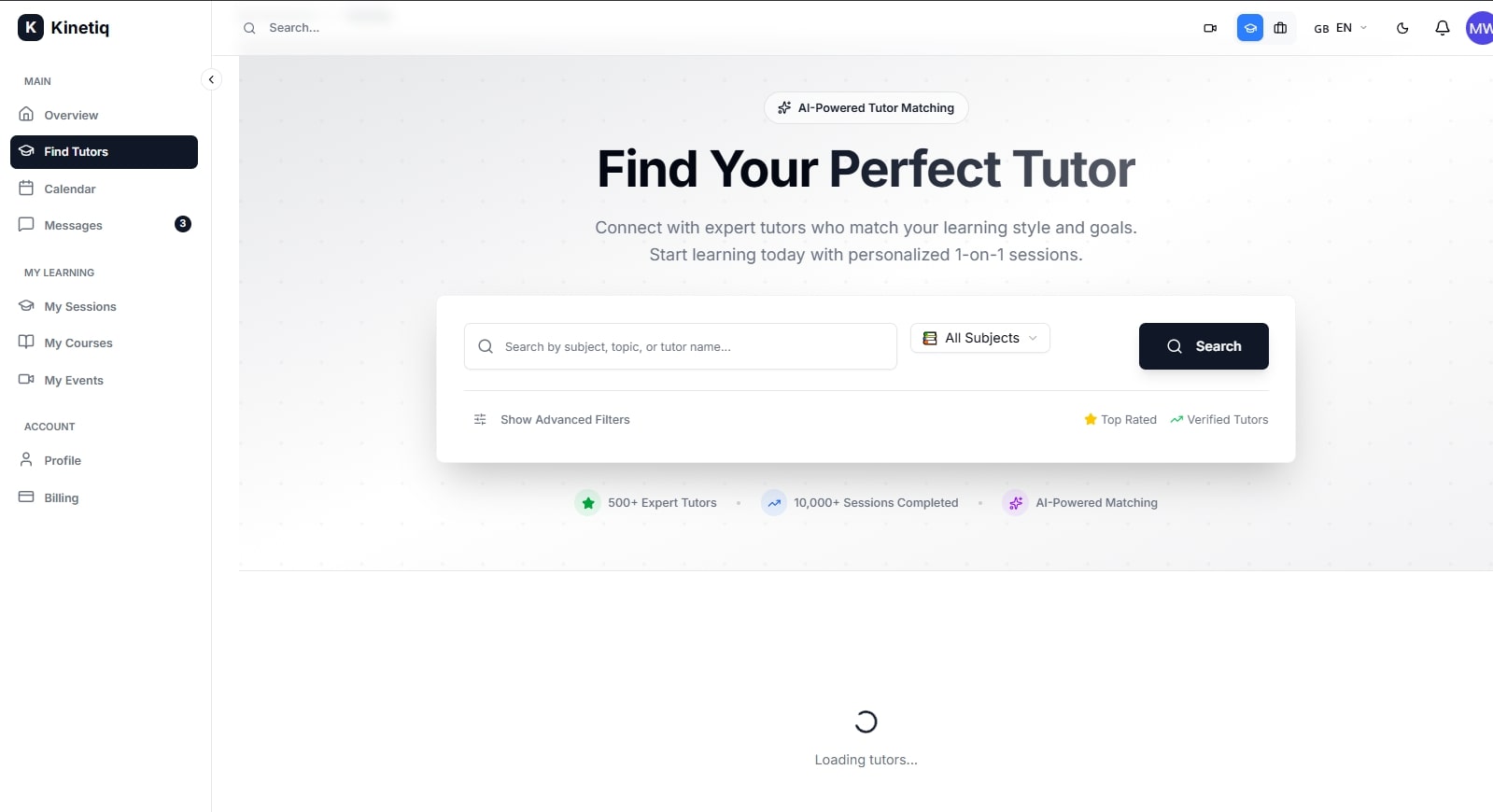
🎓1. Tutoring Marketplace - AI-Powered Matching
The marketplace of 500+ experts is the core of the platform, where Maria from Poland finds Carlos from Brazil. The matching algorithm analyzes 50+ parameters: specialization, experience, teaching styles, timezone, communication preferences, ratings from previous students, availability, and hourly rates.
Key features:
- • Smart Search with AI - natural language search ("Looking for a React teacher for mid-level with e-commerce experience")
- • Booking System - calendar integration, automatic timezone conversion, SMS/email reminders
- • Verification System - identity verification, background checks, competency certificates
- • Rating & Reviews - bidirectional teacher-student rating system with ML detection for fake reviews
- • Package Deals - purchase lesson packages with discount, automatic scheduling
Technology stack:
Backend: .NET 10, Minimal APIs, Dapper ORM
Database: PostgreSQL 16 with full-text search, GIN indexes for fast lookup
Caching: Redis 7 for sessions and popular searches (hit rate 85%)
Frontend: Next.js 15.5.4 Server Components, React Query 5.90.2 for data fetching
📚2. Self-Paced Courses - E-learning Platform
The online course platform allows teachers to create structured educational programs with videos, quizzes, assignments, and projects. AI Course Creator generates course skeletons, suggests structure, creates quizzes and homework based on topic description.
Key features:
- • Course Builder - drag & drop interface, modular structure (sections → lessons → materials)
- • AI Content Generation - GPT-4 generates quizzes (multiple choice, true/false, coding challenges), flashcards, summaries
- • Video Platform - upload to Cloudflare R2, automatic thumbnails, progress tracking
- • Progress Tracking - completion rates, time spent, quiz scores, personalized learning paths
- • Certificates - automatic certificate generation upon course completion with verifiable blockchain records
Technology stack:
Backend: .NET 10, Entity Framework Core for complex queries
AI: OpenAI GPT-4 API, prompt engineering for educational content
Storage: Cloudflare R2 for video/materials
Frontend: Next.js 15 with dynamic imports for video player, progressive loading
🎥3. Meeting Platform - Real-Time Collaboration Hub
This is Kinetiq's most technically complex product, and the place where actual education happens. LiveKit-powered video, whiteboard with Yjs CRDT, Monaco code editor for pair programming, AI assistant generating materials during lessons, real-time transcription and translation.
Key features:
- • LiveKit WebRTC Video - HD video/audio, screen sharing, adaptive bitrate, up to 50 participants
- • Collaborative Whiteboard - tldraw 2.4.6 + Yjs CRDT for conflict-free real-time sync
- • Code Editor - Monaco Editor + y-monaco for collaborative coding, syntax highlighting for 50+ languages
- • Real-Time Polls - create polls during lessons, instant results, engagement tracking
- • AI Material Generator - during lessons AI generates: problems to solve, summaries, flashcards, quizzes
- • Recording & Transcription - recording to R2, Deepgram real-time STT, GPT-4 analysis (summary, homework, topics, comprehension score)
- • Multi-language Support - live transcription in 150+ languages, automatic translation
Technology stack:
Backend: .NET 10, SignalR WebSockets
Video: LiveKit WebRTC (self-hosted), LiveKit Client SDK 2.15.8
Collaboration: Yjs CRDT + y-monaco for collaborative editing, tldraw 2.4.6 for whiteboard
AI: Deepgram API (real-time STT), OpenAI GPT-4 + Whisper (post-processing)
Frontend: React 19.1.0, Zustand 5.0.8 (local state), WebSocket connections
💬4. Messenger - Multilingual Real-Time Chat
Messenger allowing teachers and students to communicate between lessons in 150+ languages. Automatic message translation to recipient's preferred language with latency <1s.
Key features:
- • Real-Time Translation - Azure Cognitive Services Translator API, caching popular phrases in Redis
- • Rich Media - images, files, voice messages with automatic transcription (Whisper)
- • Thread Conversations - reply in context, group discussions, @mentions
- • Read Receipts & Typing - realtime indicators via SignalR
- • Message History - full-text search in PostgreSQL, infinite scroll with pagination
Technology stack:
Backend: .NET 10, SignalR hubs
Database: PostgreSQL 16 (messages), Redis 7 (online users, typing indicators)
Translation: Azure Cognitive Services, caching strategy (85% hit rate)
Frontend: React 19 with optimistic updates, virtual scrolling for performance
📅5. Events - Webinars & Conferences at Scale
The events platform allows organizing webinars and conferences for hundreds of participants simultaneously. Live interpretation, Q&A sessions, breakout rooms, networking.
Key features:
- • Event Management - creation, promotion, registration, ticketing
- • Live Streaming - LiveKit for up to 500 participants, adaptive bitrate
- • Live Interpretation - real-time audio translation for multiple languages, language track selection
- • Interactive Features - live Q&A, polls, chat, emoji reactions
- • Breakout Rooms - dividing participants into smaller groups, automatic rotation
- • Analytics - attendance tracking, engagement metrics, replay analytics
Technology stack:
Backend: .NET 10, event-driven architecture
Streaming: LiveKit SFU for scalable WebRTC, recording to Cloudflare R2
Analytics: Event tracking, engagement scoring
Frontend: Next.js 15 with Server Components for event pages, React 19 for interactive features
Key metrics and results
Twelve months after launch, Kinetiq handles hundreds of active users and thousands of sessions a month. The numbers that matter:
Active experts in marketplace
From 30+ countries, average rating 4.8/5.0
Supported translation languages
Automatic detection, real-time translation
Message translation latency
P95: 450ms, P50: 15ms (cache hit)
Platform uptime in production
Kubernetes auto-healing, zero-downtime deploys
Completed tutoring sessions
Average session duration: 45 minutes
Reduction in teacher prep time
Thanks to AI-powered content generation
Results and real-world impact
Kinetiq changed how teachers and students work together across borders. With cost optimization in the cloud and a modern .NET platform underneath, we hit the numbers we were aiming for. A few concrete examples:
Language barriers, gone
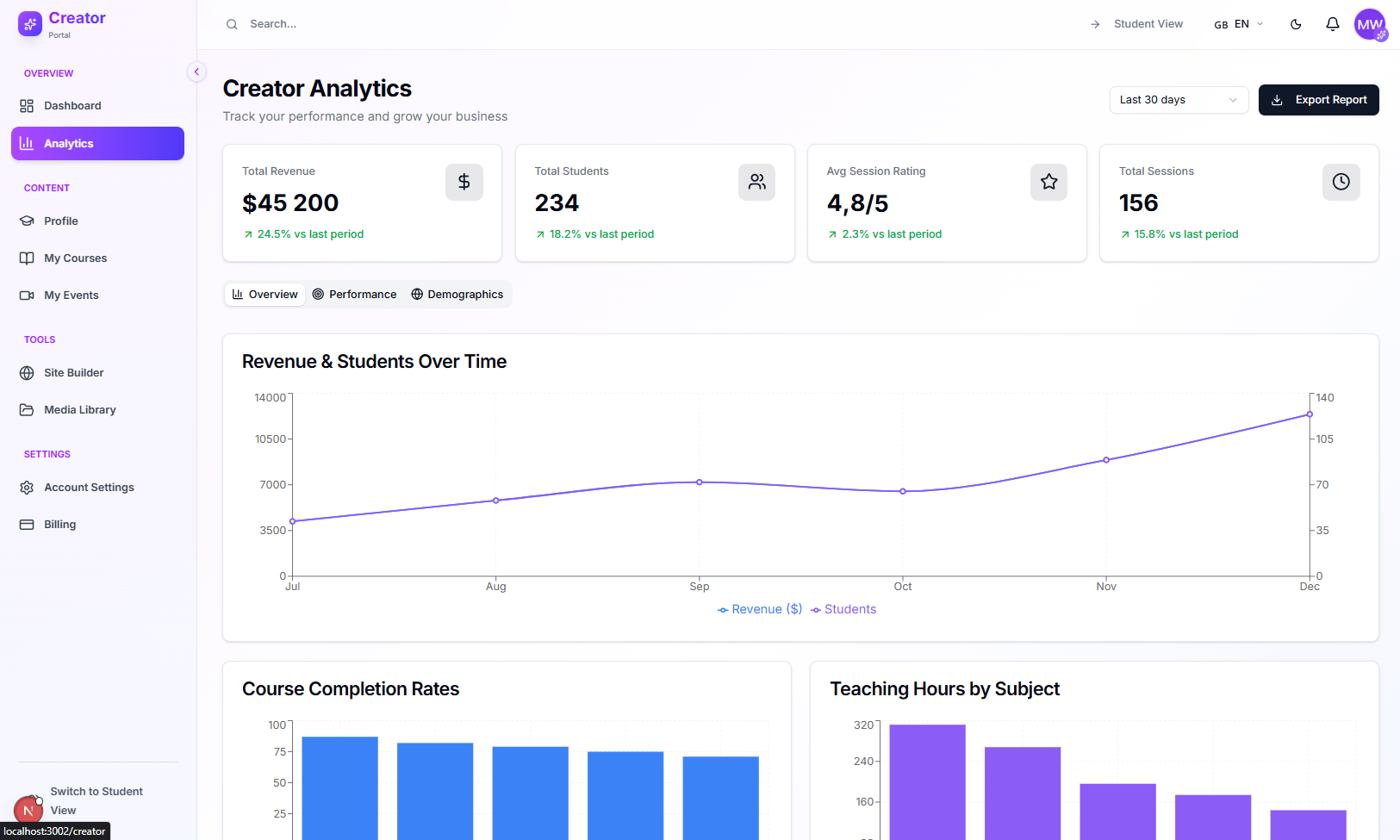
Maria, a Python teacher from Poland, now teaches students from Brazil, Japan, and India - previously she was limited to Poland and English-speaking countries. Her income increased 3x thanks to access to the global market. Average rating: 4.9/5.0 from 150+ lessons.
"Kinetiq allowed me to teach the world. Translation works so well I forget the student doesn't speak Polish. The AI assistant saves me 10 hours weekly on preparation." - Maria K., Python Tutor
AI doing the busywork
Teachers using AI Course Creator create a complete 10-hour course in 2-3 hours (previously: 20-30 hours). AI generates syllabus, quizzes, coding challenges, flashcards - teacher only reviews and customizes.
Statistics: 85% of teachers use AI features regularly. Average time saved: 8-12h/week. Satisfaction score: 4.7/5.0.
Real-time collaboration in practice
Collaborative whiteboard and code editor are used in 90% of tutoring sessions. Teachers and students solve problems together, debug code, draw diagrams - all in real-time without conflicts (thanks to Yjs CRDT).
Feedback: "The whiteboard and code editor work better than Zoom or Google Meet. Zero lag, zero conflicts. Game changer for pair programming." - Alex T., React Tutor
Technology stack and why we picked it
Every technology choice was weighed against performance, developer experience, and long-term maintainability. We went with microservices architecture on Azure Kubernetes. Here is the full stack and the reasoning behind each choice:
Frontend Stack
Next.js 15.5.4 (App Router, React Server Components)
Why: Server Components allow rendering data-heavy components on the server (tutor listings, course catalogs), reducing JavaScript bundle by 40%. App Router provides better routing, layouts, loading states. Streaming SSR for fast initial page loads.
Alternative considered: Remix - rejected due to weaker AI/ML ecosystem integration
React 19.1.0
Why: Actions API for form submissions, useOptimistic for optimistic UI updates, use() hook for async data. Concurrent rendering for smooth UX during expensive operations.
TypeScript 5.x
Why: Type safety reduces bugs by ~40% (internal stats). Better autocomplete, refactoring, documentation. Discriminated unions for complex state machines.
Tailwind CSS 4.0
Why: Rapid UI development, zero runtime CSS-in-JS overhead. Purge unused styles (final CSS: 12KB gzipped). Consistent design system with custom theme.
React Query 5.90.2 (TanStack Query)
Why: Server state management with automatic caching, background refetching, optimistic updates. Devtools for debugging. Mutations with automatic invalidation.
Zustand 5.0.8
Why: Lightweight client state (300B), zero boilerplate vs Redux. Perfect for UI state (modals, filters, sidebar). Middleware for persistence, devtools.
Radix UI
Why: Accessible primitives (Dialog, Dropdown, Tooltip) with WAI-ARIA compliance. Headless - full styling control. Keyboard navigation, focus management built-in.
Backend Stack
.NET 10 (Minimal APIs)
Why: High performance (benchmarks: 7M req/s), low latency, native async/await. Minimal APIs reduce boilerplate by 60% vs MVC. Native AOT support for cold start optimization.
Alternative considered: Node.js - rejected due to weaker performance for CPU-intensive tasks
Dapper ORM
Why: Micro-ORM, 3-5x faster than EF Core. Explicit SQL queries - zero N+1 problems. Async support, multi-mapping for complex joins. Minimal memory allocations.
PostgreSQL 16
Why: Advanced features: JSONB for flexible schemas, full-text search, GIN indexes. ACID compliance, excellent performance. Open source, zero licensing costs.
Redis 7
Why: In-memory cache with persistence. Pub/Sub for real-time events. Distributed locks (RedLock). Session storage. Data structures: strings, hashes, lists, sets, sorted sets.
SignalR WebSockets
Why: Real-time bidirectional communication. Automatic fallback (WebSockets → SSE → Long Polling). Redis backplane for scale-out. Typed hubs for type-safe communication.
Infrastructure & Services
Dapr 1.16 Service Mesh
Technology-agnostic building blocks: service invocation, pub/sub, state management, secrets, observability
LiveKit WebRTC
Open-source SFU for scalable video. Simulcast, adaptive bitrate, recording. Horizontal scaling in Kubernetes.
OpenAI GPT-4 + Whisper
Content generation (courses, quizzes, materials), session analysis, high-accuracy transcription
Deepgram API
Real-time speech-to-text with <500ms latency. Streaming WebSocket API. 150+ languages.
Cloudflare R2
S3-compatible object storage. Zero egress fees (vs AWS S3). Video/recording storage, thumbnails.
Kubernetes + Docker
Container orchestration, auto-scaling, health checks, rolling updates, service discovery
Serilog → Seq (Logging)
Structured logging with rich properties. Centralized log aggregation, search, filtering, alerting
Zipkin (Distributed Tracing)
Trace requests across microservices. Latency analysis, bottleneck identification. Dapr integration.
See Kinetiq in action
Kinetiq shows what happens when you combine AI, real-time communication, and a marketplace in one platform. Try the demo or visit the project page.
References
- [1] Microsoft Azure - Official Documentation -https://learn.microsoft.com/en-us/azure/
- [2] Microsoft Learn - Azure Training Center -https://learn.microsoft.com/en-us/training/azure/
- [3] Kubernetes - Official Documentation -https://kubernetes.io/docs/
- [4] CNCF Annual Survey 2023 - State of Kubernetes Adoption -https://www.cncf.io/reports/cncf-annual-survey-2023/
- [5] .NET - Official Microsoft Documentation -https://learn.microsoft.com/en-us/dotnet/
- [6] .NET Blog - Latest updates and best practices -https://devblogs.microsoft.com/dotnet/
- [7] MDN Web Docs - JavaScript Documentation -https://developer.mozilla.org/en-US/docs/Web/JavaScript
- [8] Stack Overflow Developer Survey 2024 -https://survey.stackoverflow.co/2024/
- [9] Next.js - Official Documentation -https://nextjs.org/docs
- [10] React - Documentation -https://react.dev/
- [11] Flexera State of the Cloud Report 2024 -https://www.flexera.com/blog/cloud/cloud-computing-trends-2024-state-of-the-cloud-report/
- [12] FinOps Foundation - Best Practices -https://www.finops.org/
- [13] Gartner - Cloud Computing Research -https://www.gartner.com/en/information-technology/insights/cloud-computing
- [14] AWS - Official Documentation -https://docs.aws.amazon.com/